
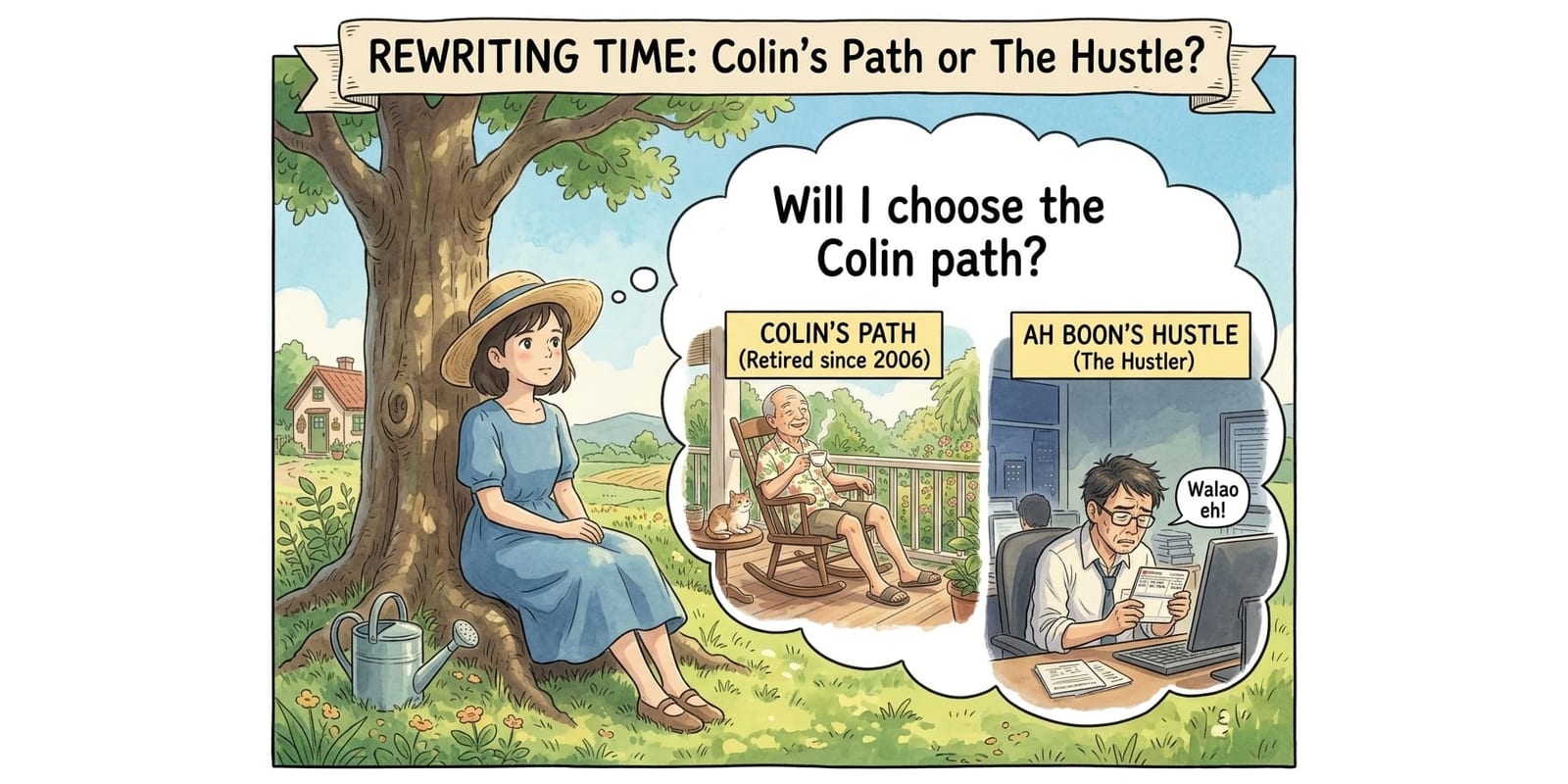
On 26 September 2006, Facebook opened registration to anyone with a valid email address. Until then, access had largely been restricted to students, workplaces and selected organisations.
That decision helped usher in an era defined by connection, comparison and constant acceleration.
Over the next two decades, we watched technology companies become global empires. Entire industries were disrupted. New careers appeared, disappeared and appeared again. People chased promotions, built businesses, traded markets, upgraded homes and tried to keep pace with an economy that rarely stopped moving.
During those same 20 years, one Singaporean quietly chose a very different path.
His name is Colin Lau.
Disclosure
This article reflects RE's personal perspective and opinion only. It is not financial advice, and individual circumstances, responsibilities and risks differ. We hold no affiliate, sponsorship or commercial relationship connected to anyone named in this piece.
The man who retired at 35
CNA recently profiled Lau, who lost his teaching job at the age of 35. Instead of searching for another position, he used his savings to buy an ageing three-room HDB flat outright for S$87,000.
The flat had approximately 64 years remaining on its lease. Coincidentally, its lease began in the year he was born, which meant it could theoretically remain his home until he turned 99.
Lau then rented out a spare room. He currently receives about S$900 a month in rental income, supplemented by payouts from insurance policies that matured during his retirement. Together, these provide him with approximately S$2,500 each month.
His reported personal expenses are below S$150 a month.
According to CNA, Lau has not returned to conventional employment since losing his job. He spends his time reading, listening to music and podcasts, learning, caring for his dog and supporting charitable efforts.
This is not the conventional Singaporean retirement story.
There was no multimillion-dollar portfolio, property empire or spectacular business exit. His freedom came from owning an inexpensive home, keeping his needs unusually small and structuring his life so that modest recurring income could cover them.
The same 20 years, lived differently
To explore your own monthly picture, try the Enough Point Check, our interactive cash-flow check.
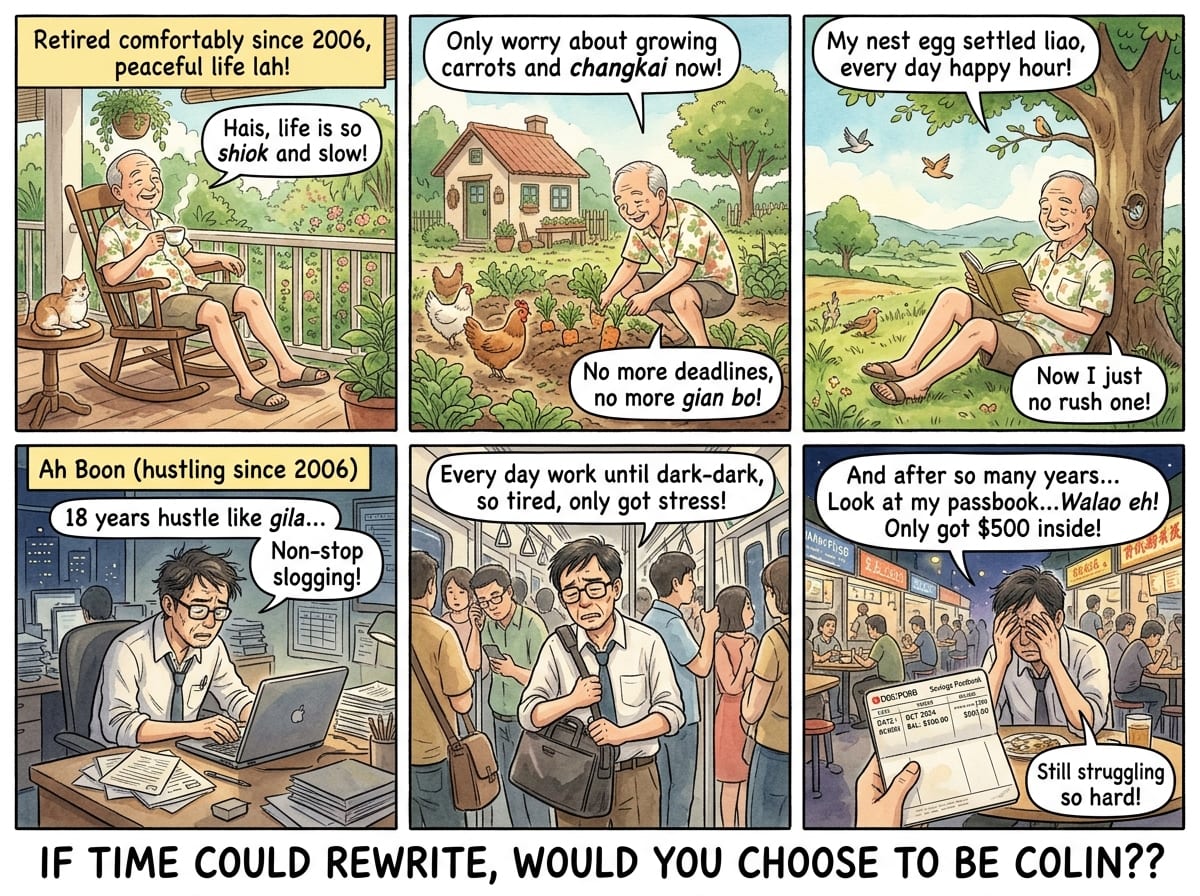
Lau’s story stayed with me because of the period it spans.
While Facebook grew into one of the world’s most influential companies, Lau was living quietly in the same flat.
While many of us spent the last two decades studying, working, investing, upgrading and worrying about what came next, he had already removed employment from the centre of his life.
That does not mean he experienced no difficulty. CNA reported that he recently endured a serious health crisis involving 15 surgeries and 62 days in hospital. Insurance coverage, MediSave and subsidies protected him from paying the hospital bill out of pocket, but the experience also highlighted the uncertainty of future healthcare and long-term care costs.
His life is not free from risk. It is simply organised around a very different set of risks and priorities.
This is not my ideal life
I do not see Lau’s lifestyle as a gold standard that everyone should follow.
My children are central to my life. Raising them brings expenses, responsibilities and constraints that Lau, who does not have children, did not need to plan for.
I also would not want to reduce my spending to his level. There are experiences I value, comforts I enjoy and commitments I am willing to work for.
Lau bought his flat in 2007. CNA notes that comparable older flats now cost considerably more relative to starting salaries. Replicating his exact path today would therefore be difficult even for someone prepared to make the same sacrifices.
His approach also depended on several things coming together: substantial savings, an inexpensive property bought without a mortgage, rental income, mature insurance policies and an exceptionally low-cost lifestyle.
It is not a simple formula for early retirement.
But dismissing his story because it is extreme would miss its most useful lesson.
Enough is not a universal number
Financial freedom is often presented as a target number.
Accumulate 25 times annual expenses. Build a million-dollar portfolio. Generate enough passive income to replace a salary. Reach a particular net worth by a particular age.
These frameworks can be useful, but they begin with an assumption: that our current level of spending represents the life we must continue financing.
Lau reversed the calculation.
Instead of asking how much wealth he needed to sustain an expanding lifestyle, he decided what kind of life was sufficient—and made his finances serve that life.
His enough point was not based on what his peers owned, what advertisers encouraged him to want or what society considered successful.
It was personal.
For him, enough meant secure shelter, extremely low expenses, modest recurring income, free or inexpensive interests and control over his time.
For someone else, enough may include children, travel, a larger home, elderly parents, meaningful work or the ability to support causes that matter.
The amount changes because the life behind it changes.
The question beneath the numbers
Singapore conditions us to prepare for the next milestone.
The next examination. The next promotion. The next property. The next investment target. The next level of financial security.
There is nothing wrong with ambition. Building a career, growing a business or accumulating wealth can be deeply meaningful.
The danger appears when progress becomes automatic—when every achievement merely creates another requirement, without bringing us closer to a life we have consciously chosen.
Lau’s story asks an uncomfortable question:
If I never define what enough looks like, how will I recognise it when I arrive?
Without that definition, more will always appear safer.
Another promotion creates more security. Another property creates more options. Another year of work strengthens the buffer. Every step can be justified, even when the destination remains undefined.
An enough point does not have to mean retiring at 35. It may mean having the freedom to reject unsuitable work, spend more time with family, pursue a smaller business, care for ageing parents or simply stop measuring life through continuous financial expansion.
Redefining my enough point
My own enough point will look nothing like Colin Lau’s.
It must account for my children, the future I want to give them and the experiences I still want to have. It will require more money, more work and more complexity than his life does.
But his example reminds me that my enough point should still be mine.
It should not be inherited unquestioningly from Singapore’s default definition of success. It should not expand every time my income does. And it should not be determined entirely by comparison with people whose lives, responsibilities and ambitions are different from my own.
Lau may have chosen an extreme version of enough.
Yet after 20 years of living outside the conventional race, he offers a valuable counterpoint to a world that constantly tells us to want more.
Perhaps the goal is not to copy his answer.
Perhaps the goal is finally to define our own.
This article reflects RE’s personal perspective and is not financial advice. Individual circumstances, responsibilities and risks differ.
Sources: CNA’s profile of Colin Lau, published 4 August 2026; Meta’s announcement opening Facebook registration more broadly, dated 26 September 2006.